0%

优先队列--堆

虽然求最小值的操作可以在常数时间完成,但是,按照最小元设计的堆(也称作最小堆)在求最大元方面却无任何帮助,事实上,一个堆所蕴含的关于序的信息很有限,因此,若不对整个堆进行线性搜索,是没有办法找出任何特定的关键字的。(《数据结构与算法分析——C语言描述》之6.3.4节)

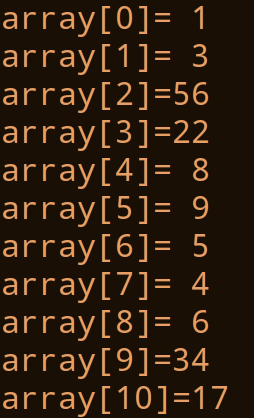
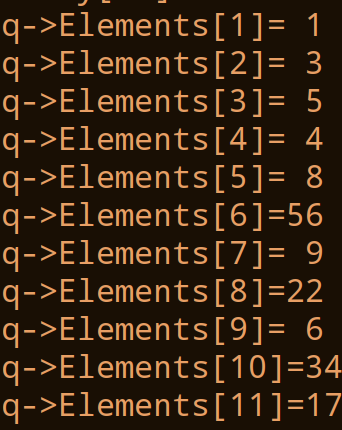
从下面第二个图也可以看出,数据仅仅只是局部有序,整体来看并无顺序可言。可以使用该方法来找出最小或者最大的数。

1
2
3
4
5
6
7
8
9
10
11
12
13
14
15
16
17
18
19
20
21
22
23
#ifndef _BINHEAP_H_
#define _BINHEAP_H_

typedef int ElementType;
struct HeapStruct
{
int Capacity;
int Size;
ElementType *Elements;
};

typedef struct HeapStruct *PriorityQueue;

PriorityQueue Initialize(int MaxElements);
void Destroy(PriorityQueue H);
void MakeEmpty(PriorityQueue H);
void Insert(ElementType x,PriorityQueue H);
ElementType DeleteMin(PriorityQueue H);
ElementType FindMin(PriorityQueue H);
int IsEmpty(PriorityQueue H);
int IsFull(PriorityQueue H);

#endif
1
2
3
4
5
6
7
8
9
10
11
12
13
14
15
16
17
18
19
20
21
22
23
24
25
26
27
28
29
30
31
32
33
34
35
36
37
38
39
40
41
42
43
44
45
46
47
48
49
50
51
52
53
54
55
56
57
58
59
60
61
62
63
64
65
66
67
68
69
70
71
72
73
74
75
76
77
78
79
80
81
82
83
84
85
86
87
88
89
90
91
92
93
94
95
96
97
98
99
100
101
102
103
104
105
106
107
108
#include <stdio.h>
#include <stdlib.h>
#include "heap.h"

#define MinPQSize 5
#define Mindata 0

int IsFull(PriorityQueue H)
{
return H->Size == H->Capacity;
}

int IsEmpty(PriorityQueue H)
{
return H->Size==0?1:0;
}

PriorityQueue Initialize(int MaxElements)
{
PriorityQueue H;

if(MaxElements < MinPQSize)
{
printf("priority queue size is too small\n");
return NULL;
}

H=(PriorityQueue)malloc(sizeof(struct HeapStruct));
if(H==NULL)
{
printf("malloc error\n");
return NULL;
}

H->Elements=malloc((MaxElements+1)*sizeof(ElementType));
if(H->Elements==NULL)
{
printf("H->elements malloc error\n");
free(H);
return NULL;
}

H->Capacity=MaxElements;
H->Size=0;
H->Elements[0]=Mindata;

return H;
}

void Destroy(PriorityQueue H)
{
free(H->Elements);
free(H);
}

void Insert(ElementType X ,PriorityQueue H)
{
int i;

if(IsFull(H))
{
printf("Priority Queue is full\n");
return;
}

/*
对于数组任意位置i上的元素,起左儿子在位置2i,右儿子在2i+1,他的父亲则在位置[i/2]上。
数组从1开始
*/
for (i = ++H->Size; H->Elements[i/2] > X; i/=2)
{
H->Elements[i]=H->Elements[i/2];
}
H->Elements[i]=X;
}

ElementType DeleteMin(PriorityQueue H)
{
int i,Child;
ElementType MinElement,LastElement;

if(IsEmpty(H))
{
printf("Priority queue is empty\n");
return H->Elements[0];
}

MinElement=H->Elements[1];
LastElement=H->Elements[H->Size--];
for (i=1;i*2<=H->Size;i=Child)
{
Child=i*2;
if(Child!=H->Size && H->Elements[Child+1]<H->Elements[Child])
{
Child++;
}
if(LastElement>H->Elements[Child])
{
H->Elements[i]=H->Elements[Child];
}
else
{
break;
}
}
H->Elements[i]=LastElement;
return MinElement;
}
1
2
3
4
5
6
7
8
9
10
11
12
13
14
15
16
17
18
19
20
21
22
23
24
25
26
27
28
29
30
31
32
33
#include <stdio.h>
#include "heap.h"

int main(void)
{
PriorityQueue q=Initialize(16);
int array[]={1,3,56,22,8,9,5,4,6,34,17};
int i;

if(q==NULL)
{
printf("q malloc error\n");
return 0;
}

for(i=0;i<sizeof(array)/sizeof(int);i++)
{
Insert(array[i],q);
printf("array[%d]=%2d\n",i,array[i]);
}

for(i=1;i<sizeof(array)/sizeof(int)+1;i++)
{
printf("q->Elements[%d]=%2d\n",i,q->Elements[i]);
}

for(i=0;i<sizeof(array)/sizeof(int);i++)
{
printf("%d:%d\n",i+1,DeleteMin(q));
}

return 0;
}
1
2
$ gcc -o main main.c  heap.c ^C
$ ./main
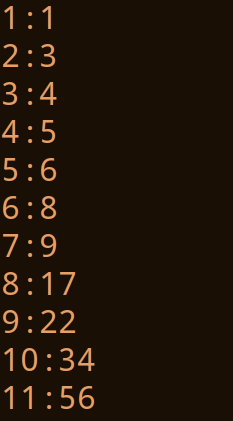
2RabgH.png 2RaXDI.png 2Rdivj.png

其它应用方面。比如可能有一些作业特别重要,需要打印机一有空闲就来处理该作业。这就相当于在一系列的任务中,优先执行一个高优先级的任务。这里说一个实际案例。

在自动抄表中,集中器会自动地定时的进行抄表,并将数据上传至服务器。如果此时服务器端有手动的抄表动作,那么集中器需要暂停当前的自动抄表动作,而去执行服务器的抄表动作。一是因为一个集中器设备下面会有很多的表,完成所有的抄表动作需要一定的时间;二是提高服务器端的响应时间,属于一种人性化设计,否则服务器端可能需要等待几分钟才能看到所要的结果,给人的感觉就不好。

当然服务器端也可以实现自动抄表,集中器采集器仅仅作为数据转发设备,该方案此处不提。当时的设计是在集中器实现自动抄表。优先响应服务器的抄表指令使用的是高优先级任务的方式,即每完成一次抄表,检查是否有服务器抄表命令,如果有那么就进行一次任务调度,执行服务器抄表指令,否则继续执行自动抄表。为何需要在每次抄表完成后才去检查?这涉及到抄表的执行流程,简单说来就是:集中器发送抄表指令,表计会通过总线接收指令,之后进行应答,集中器接收数据。这个过程需要一定的时间,并且因为所有表计均挂在总线上,所以一定要等待上一次抄表完成之后才能进行下一次抄表,否则数据就会冲突。


堆排序(2021-6-11 16:48:45)

直接将数组中的数据变为堆的形式,数据取出之后还是放入数组中,结果就是升序或者降序排列。

1
2
3
4
5
6
7
8
9
10
11
12
13
14
15
16
17
18
19
20
21
22
23
24
25
26
27
28
29
30
31
32
33
34
35
36
37
38
39
40
41
42
43
44
45
46
47
48
49
50
51
52
53
54
55
56
57
58
59
60
61
62
63
64
65
66
67
68
69
70
71
72
73
74
75
76
77
78
79
80
81
82
83
84
85
86
87
88
89
90
91
92
93
94
95
96
97
98
99
100
101
102
103
104
105
106
107
108
109
110
111
112
113
114
115
116
117

/****************************************************/
/*堆排序*/
void Swap(int *a,int *b)
{
int tmp=*a;

*a=*b;
*b=tmp;
}

#define LeftChiild(i) (2*(i)+1)
void PercDown(ElementType A[],int i,int N)
{
int Child;
ElementType Tmp;

for (Tmp=A[i];LeftChiild(i)<N;i=Child)
{
Child=LeftChiild(i);
if(Child!=N-1 && A[Child+1]>A[Child])
{
Child++;
}
if(Tmp<A[Child])
{
A[i]=A[Child];
}
else
{
break;
}
}
A[i]=Tmp;
}

void HeapSort(ElementType A[],int N)
{
int i;

for(i=N/2;i>=0;i--)//buile heap
{
PercDown(A,i,N);
}

for(i=N-1;i>0;i--)//delete max
{
Swap(&A[0],&A[i]);
PercDown(A,0,i);
}
}

void PercUp(ElementType A[],int i,int N)
{
int Child;
ElementType Tmp;

for (Tmp=A[i];LeftChiild(i)<N;i=Child)
{
Child=LeftChiild(i);
if(Child!=N-1 && A[Child+1]<A[Child])
{
Child++;
}
if(Tmp>A[Child])
{
A[i]=A[Child];
}
else
{
break;
}
}
A[i]=Tmp;
}

void HeapSort_UP(ElementType A[],int N)
{
int i;

for(i=N/2;i>=0;i--)//buile heap
{
PercUp(A,i,N);
}

for(i=N-1;i>0;i--)//delete max
{
Swap(&A[0],&A[i]);
PercUp(A,0,i);
}
}

int main(void)
{
PriorityQueue q=Initialize(16);
int array[]={1,3,56,22,8,9,5,4,6,34,17};
int i;

/****************************************************/
printf("HeapSort:\n");
#if 1// 升序
HeapSort(array,sizeof(array)/sizeof(int));//最大堆
for(i=0;i<sizeof(array)/sizeof(int);i++)
{
printf("array[%d]=%2d\n",i,array[i]);
}
#else //降序
/****************************************************/
HeapSort_UP(array,sizeof(array)/sizeof(int));//最小堆
for(i=0;i<sizeof(array)/sizeof(int);i++)
{
printf("array[%d]=%2d\n",i,array[i]);
}
#endif
/****************************************************/
return 0;
}

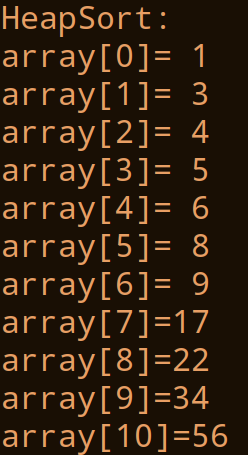
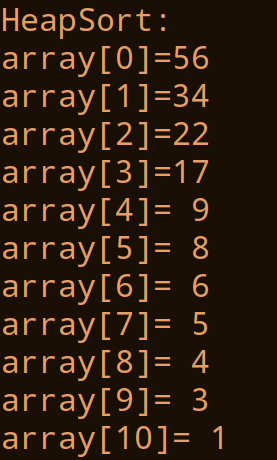
运行结果如下

2fRFs0.png 2fRJoD.png